
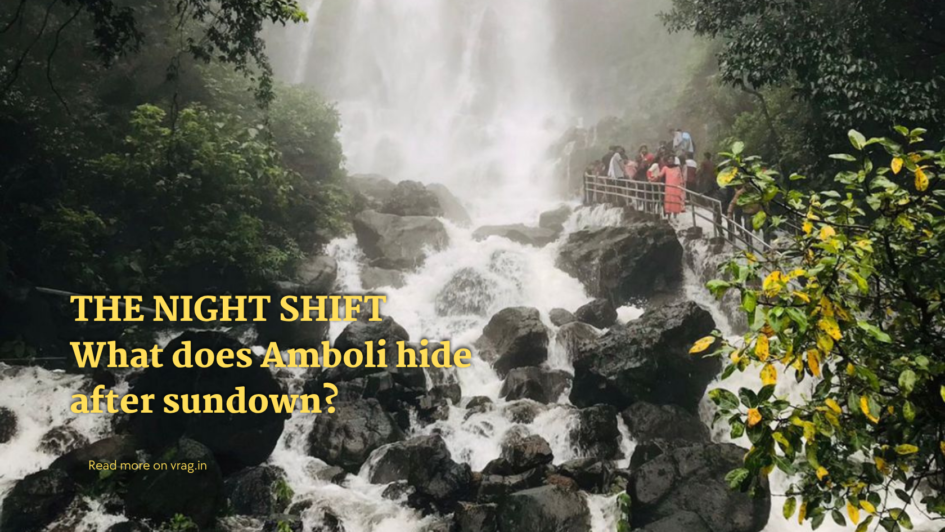
Despite being a localite, I still haven’t been to the waterfalls; I’ve just clicked a photo or two standing below. But have you seen the real Amboli, the one during the night? How does nature change in Amboli at night? Everyone comes to Amboli for the same photo with the waterfall as the background. Some get the drone shots, stand on the edge of the ghat with a waterfall behind, and a few of them stand on their knees in the heavy mist.
Table of Contents
The road goes quiet, and then it doesn’t
As soon as the sun sets, nature slows down for its beauty. The day-trippers have packed up and driven back down towards Sawantwadi and Goa. The famous Amboli Waterfalls on the ghat road feel empty at night. Finally, some time when nature breathes and the selfie sticks disappear.
Amboli sits high in the Western Ghats and has heavy rainfall each year. Naturally surrounded by lush green forest, it looks picturesque during the monsoons. Also called the “Cherrapunji of Maharashtra”. It’s completely different at night, a little scary, but for nature lovers it is definitely a once-in-a-lifetime experience.
The mist doesn’t help you, either. During the day, it’s atmospheric, photogenic, and soft. At night, it swallows your headlights whole and hands you back about four feet of visibility. You have to slow right down. You roll the window a crack. And suddenly, you’re not looking at Amboli anymore, but you’re listening to it.
Water that made history!
There’s a reason all of this exists, and it comes back to the water. Did you know that in 2021, the Maharashtra government declared Amboli a Biodiversity Heritage Site? What tipped it over the edge was a fish. A small, colourful freshwater loach that researchers found living mostly in a temple pond right here, fed by a spring coming straight out of the rock. They named it Schistura hiranyakeshi, after the Hiranyakeshi river that begins its life in Amboli.
A creature that lives nowhere else on the planet, resting quietly in the same water that eventually becomes the waterfalls everyone films for ten seconds and scrolls past. When I stand near those falls at night, that’s what’s running through my head. Not the shot. The fact that this whole place is basically one big living thing, with the water as its bloodstream.
Why Amboli at night is the honest version
During the day, Amboli is for us, just like a small outstanding natural performance. It hands you that aesthetic, raw yet pure postcard: the viewpoint, the mist, the tea stall, hot pakodas, the falls framed just so. It’s all calm yet lovely.
Amboli at night stops performing. It doesn’t care whether you’re there. The frogs call whether or not you’re filming. The waterfall roars into the dark, whether or not anyone’s around to hear it. And I often imagine this in my head: standing in the middle of all that, the torch switched off for just a second, soaked, slightly scared, grinning like a fool, is the closest I’ve ever felt to actually meeting this place and nature at its best. That’s the version I wish more people came for. Not the arms-out photo, and not being irresponsible toward nature by throwing trash or making fun of the monkeys around. The other one. The one you can’t really photograph at all.
Before you go
Amboli has several species of herpetofauna. It is quite a visual treat to watch them do their magic at night. (I did some research online, you must definitely search for the term Amboli at night too)
- Rare Amphibians: The endangered Amboli Tiger Toad, the endemic Amboli Bush Frog, and the Malabar Gliding Frog.
- Unique Reptiles: The venomous Malabar Pit Viper (on wet branches) and the camouflaged, mild-venomous Green Vine Snake.
- Bioluminescent Fungi
- Different insects species
This is a protected and fragile place. Keep your voice down. Watch where you put your feet. Don’t touch, grab, or move things around to get a better frame. Always take a local guide; they know which leaf to turn over and, more importantly, which one to leave alone.
Amboli’s waterfalls will always look good in daylight. But if you want to know this place, wait for Amboli at night. Just listen to all that water finding its way down the mountain, exactly the way it has for far longer than any of us have been around to watch. The day belongs to the visitors. Amboli at night is yours, a gift of nature. Read about other places in Amboli here.
This blog post is part of ‘Blogaberry Dazzle’
hosted by Cindy D’Silva and Noor Anand Chawla
in collaboration with Mister Tikku.














July 18, 2026 at 7:42 pm
You seem to be pretty daring. I am sure you had company. I would be really scared to walk there in the dark. Not that I am frightened, just that there must be so many creepy crawlies and they may crawl over me 🙂 The sound of the water itself must be deafening. I have never been to Amboli, actually.
July 19, 2026 at 1:09 am
Hehehe no I could never dare to, I’ve been on a virtual tour through posts and reels. Just trying to be curious through this post and not many of them know it for the natural beauty at night and many of them visit it for the waterfalls view. Next time if you plan a road trip to Goa do it via Amboli Ghat, during the daytime it feels quite pleasant and they even have homestays around so a small night trip in the vicinity would be a good choice too.
July 19, 2026 at 12:45 pm
Damn, this post just intrigued me. As far as I know waterfalls are a day thing, now that you talked about waterfall at night, it first sends shiver down the spine, and then excites the adventurous seeking side of me.
July 21, 2026 at 12:37 am
Ha, that shiver-then-excitement is exactly what I was hoping to spark! Amboli after dark is a whole different world with glowing fungi and frogs. Go with a local guide 🙂
July 21, 2026 at 9:42 am
Your post has me so excited. I would love to explore Amboli in day and night. I can just imagine the beautiful fauna and the misty waterfall, the water falling into a gorge at night, roaring and scary, yet scary. What an awesome experience.
July 21, 2026 at 4:14 pm
I hope you get to experience both for yourself soon.
July 21, 2026 at 2:03 pm
What a mesmerizing glimpse of Amboli at night! Nature truly has its own magic. This made me want to experience the mystery and beauty of Amboli after sunset!
July 21, 2026 at 4:16 pm
Thank you so much! That magic is exactly what makes Amboli after sunset so special. It really does feel like the forest saves its best secrets for the dark.
July 21, 2026 at 8:34 pm
You got me there already. This moves right up to my next travel plan
July 21, 2026 at 10:10 pm
Yay, you will definitely love it here.
July 22, 2026 at 1:55 pm
I was hoping to see a picture of the Amboli by night. Quite an interesting place. Thanks for drawing attention to important facts about it.
August 4, 2026 at 11:53 pm
I so wish I had a night picture. Thank you for reading the important facts.
July 22, 2026 at 8:16 pm
Well, I love water be it any form but when it comes with a daring combinations of mountains it always scared me and when its about night time… Gosh!!!!! i will never go … The reason is not the scary sound of the waterfalls when every things else takes a step back to rest. The reason is the mountains… in the morning I can appreciate the beauty of mountains and its views but no way at night … you can call it a phobia… it chocks my breath as if I am captivated at the midst of dark nature. Adventure is cool for me till the time it dont scares me. I will prefer to be in Amboli , day time
August 5, 2026 at 12:06 am
You seem to love nature. If so, please do visit the waterfalls during the day.
July 22, 2026 at 10:06 pm
I love how we have these installations by nature all over our country that calls to our sense of wonder and adventure. Nature outdoes itself everytime.
July 23, 2026 at 12:02 am
Wow I never knew about this place and how beautiful it is! Another confirmation of how big and beautiful our country is!
August 5, 2026 at 12:08 am
Oh yes, there are so many beautiful places in India.
July 23, 2026 at 12:26 am
Wow, I haven’t been to this place before and though I don’t have an adventurous bone in my body, I would still like to explore.
August 5, 2026 at 12:09 am
If you would please visit it once during the day time and I’m sure you will make night plans soon.
July 23, 2026 at 12:58 am
The line about the waterfall not caring whether you’re there, roaring into the dark whether or not anyone’s listening, really got me. That tiny fish found only in a temple pond, tied to the same river feeding those falls, is such a beautiful detail most people would totally scroll past. Definitely adding Amboli after dark to the list, though I’ll be dragging a local guide along for those pit vipers.
August 5, 2026 at 12:15 am
Yaay, I’m sure this will be the most memorable trip. The feeling to be near the waterfalls is quite surreal.
July 23, 2026 at 1:01 am
I love how you put it in the post.
August 5, 2026 at 12:16 am
Thank you so much.
July 23, 2026 at 8:05 pm
That endemic loach fact was fascinating. Amboli at night sounds equal parts scary and magical. Loved the line about listening instead of photographing. Definitely adding this to my travel bucket list.
August 5, 2026 at 12:31 am
This made my day, thank you for reading right to the end! When you do tick it off the bucket list keep the camera down for a bit and just let the forest talk. You will love it.
July 23, 2026 at 8:46 pm
I’ve heard about Amboli but never knew it was so beautiful and adventurous. Definitely need to check it out. Have driven through the Western ghats during monsoon though and that’s an experience one can’t forget!
August 5, 2026 at 12:31 am
Oh yes, you will definitely love it dear.
July 24, 2026 at 4:27 pm
I never thought of experiencing a waterfall at night, but the way you described it made it feel so peaceful and magical. Definitely adding Amboli to my travel list.
August 5, 2026 at 12:33 am
Exactly I’m that curious kind hence a little imagination and some interesting videos helped me write this piece.
August 11, 2026 at 8:19 pm
Beautiful! I was transported vicariously at Amboli.